PineBridge Investments
Multi-asset, equity and fixed income research from PineBridge Investments.
United States5 articlesLast published 9 Jun 2026
Multi-AssetEquitiesFixed Income
Research

PineBridge InvestmentsMulti-Asset
Investment Strategy Insights: A Once-in-a-Generation Tech Buildout and the Coming Productivity Supercycle
PineBridge's multi-asset strategy team argues that AI is transitioning from a narrative-driven theme to a measurable driver of corporate earnings, macro productivity, and capital expenditure, dismissing bubble concerns on the basis that valuations have lagged delivered earnings growth. The piece also covers global macro, rates, credit, currency, and EM fixed income through the lens of an ongoing Middle East conflict disrupting the Strait of Hormuz and its inflationary consequences for developed and emerging markets.
9 Jun 2026

PineBridge InvestmentsFixed Income
Leveraged Finance Asset Allocation Insights: Navigating the AI Credit Divide
PineBridge Investments presents its quarterly leveraged finance outlook, arguing that AI-driven disruption is creating a structural credit divide: technology hardware and utility power providers benefit from data center expansion, while enterprise software and tech-enabled business services face revenue erosion, making high yield bonds preferable to leveraged loans given the loan market's heavy software concentration and maturity wall risks. CLO managers are actively de-risking software exposures, while strong institutional and retail ETF demand continues to support CLO spreads despite elevated left-tail risks from persistent inflation and geopolitical uncertainty.
5 Jun 2026
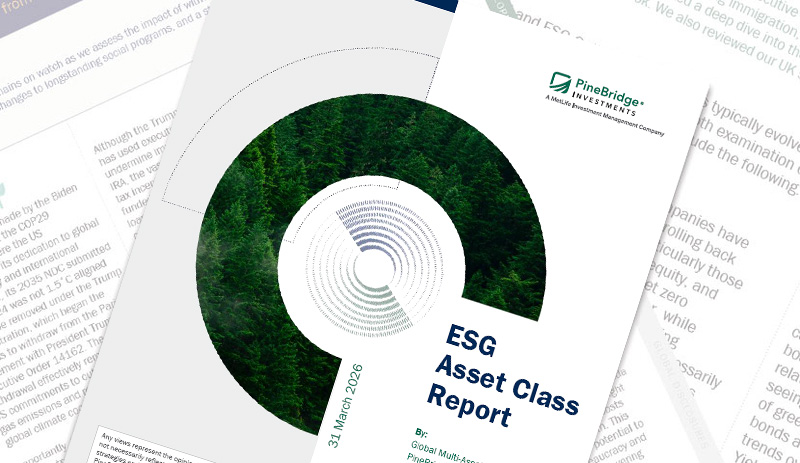
Global Multi-Asset ESG Report: 2H25
PineBridge Investments' Global Multi-Asset team presents its biannual ESG report tracking environmental, social, and governance developments across 50 asset classes worldwide. The report provides updates on global ESG trends and notable regional developments, informing the team's asset class convictions to optimize both ESG impact and alpha potential.
15 May 2026

PineBridge InvestmentsMulti-Asset
Investment Strategy Insights: The Strait’s Fate and Timing Have Diverging Sector Impacts
PineBridge's multi-asset team analyzes how the closure of the Strait of Hormuz - framed as a temporary shock rather than a regime shift - creates diverging impacts across energy, food, and chemicals sectors depending on the duration of disruption. The piece includes conviction scores and views across global macro, rates, credit, FX, emerging markets fixed income, and multi-asset, with a broadly cautious but modestly constructive overall tone.
8 May 2026

PineBridge InvestmentsMulti-Asset
Capital Market Line: A Passing Energy Shock Meets a Lasting Productivity Surge
PineBridge Investments' quarterly Capital Market Line update (as of 31 March 2026) argues that near-term energy-driven stagflation from the Iran conflict is a transient headwind, while an AI-led productivity surge and massive global investment wave are structural forces that will lift ROIC, equities, and real rates over the medium term. The piece provides actionable cross-asset positioning guidance - favouring AI-linked equities, extending duration toward market norms, preferring high yield over investment grade credit, and rotating from gold back toward longer duration as real rates normalise.
21 Apr 2026